
Dark spots are often more frustrating than the breakout itself. They can linger for weeks—or even months—making it feel like your skin never fully clears. That’s why niacinamide has become one of the most talked-about ingredients for fading post-acne marks and uneven pigmentation.
But here’s the part many beginners don’t hear: buying a niacinamide serum isn’t enough. The percentage you choose, how you layer it, how long you stick with it, and whether you wear sunscreen every day all have a much bigger impact on your results than the product name on the bottle.
In this guide, you’ll learn what niacinamide can realistically do for dark spots, how to use it without irritating your skin, and how to avoid the common mistakes that keep pigmentation from fading.
✨ Before You Start
If you’re short on time, here’s what you need to know before buying another niacinamide serum:
- Niacinamide can help fade dark spots, especially post-acne marks and mild hyperpigmentation, but it won’t erase them overnight.
- Most beginners get the best results with a 5% formula. Higher concentrations aren’t always more effective and can increase irritation.
- Visible improvement usually takes 6–8 weeks, with more noticeable fading after about 3 months of consistent use.
- Daily sunscreen is essential. Without SPF, new UV damage can slow or even reverse your progress.
- A simple routine beats an overloaded one. Niacinamide works best when your skin barrier stays healthy.
In this guide, you’ll learn:
- How niacinamide actually fades dark spots
- Which concentration is right for your skin
- How to build a beginner-friendly routine
- Budget-friendly products worth considering
- Common mistakes that prevent dark spots from fading
What Are Dark Spots — and Can Niacinamide Really Help?
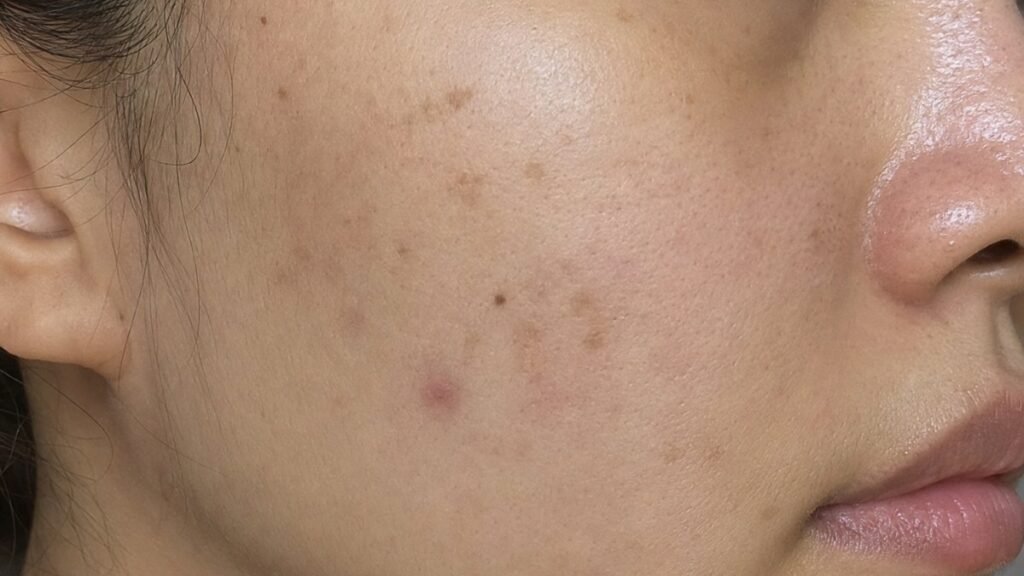
Different Types of Dark Spots
Not all dark spots respond to niacinamide the same way — and knowing which type you have sets realistic expectations before you even open the bottle.
Acne marks (post-inflammatory hyperpigmentation, or PIH): These are the flat dark spots left behind after a pimple heals. They’re not scars — they’re pigmentation, which means they respond well to ingredients that interrupt melanin production. Niacinamide works well here, especially on mild to moderate marks.
Sun spots (solar lentigines): Flat brown spots caused by cumulative UV exposure, usually appearing on areas that see the most sun — cheeks, nose, forehead. Niacinamide can help fade these over time, but they typically need more patience than acne marks because the pigment is often deeper.
Post-inflammatory hyperpigmentation from other causes: Redness or darkening from eczema, rosacea, or general inflammation. Niacinamide helps here too, partly because it’s anti-inflammatory and partly because it interrupts the pigmentation process.
Melasma: Hormonally-driven pigmentation that often appears symmetrically across the cheeks, forehead, and upper lip. Niacinamide can provide modest improvement, but melasma is one of the more stubborn pigmentation conditions and often requires prescription-level treatment for significant results. If your dark spots are symmetrical and appeared or worsened during pregnancy or with hormonal contraception, mention this to a dermatologist.
Why Some Dark Spots Fade Faster Than Others
Fresh, shallow acne marks on lighter skin tones with consistent sun protection often start fading within 6-8 weeks. Older, deeper spots — or spots on deeper skin tones where melanin production is more active — can take 3-6 months of consistent treatment to show meaningful improvement.
This isn’t a reason to be discouraged. It’s a reason to start now rather than waiting until a spot gets worse, and to not abandon your routine at week four when you haven’t seen a visible change yet.
What Is Niacinamide and How Does It Actually Fade Dark Spots?
Niacinamide in Simple Terms
Niacinamide is vitamin B3. It’s in a lot of skincare products because it does a lot of things — but for dark spots specifically, here’s what’s actually happening:
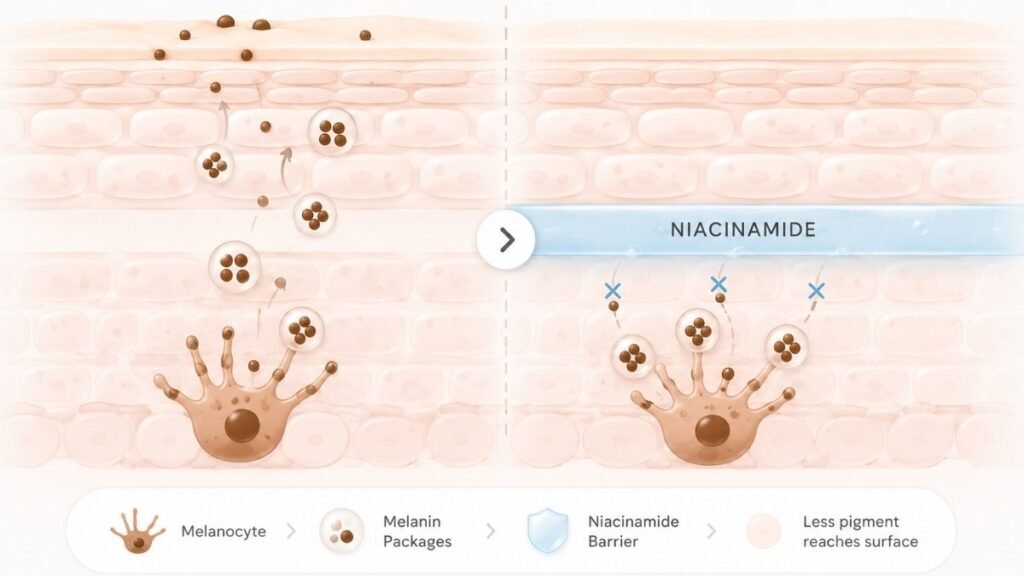
Your skin produces melanin (pigment) in cells called melanocytes. That melanin gets packaged and transported up through your skin layers, eventually reaching the surface where you see it as a dark spot.
Think of niacinamide as a package interception system. It doesn’t stop melanin from being produced at the source. Instead, it blocks the transfer of those pigment packages from the melanocytes to the surrounding skin cells. Less melanin reaching the surface means spots gradually fade as your skin naturally renews itself.
This is why niacinamide takes weeks to show results — it works on the process, not the pigment that’s already there. You’re waiting for your skin to cycle through and reveal cells that received less melanin because of what niacinamide was doing underneath.
Why It’s Different from Whitening Ingredients That Peel the Skin
Some brightening ingredients — high-strength AHAs, certain peels, some older lightening agents — work by aggressively exfoliating the top layers of skin to reveal fresher skin underneath faster. This can be effective, but it’s also more irritating and can backfire badly on darker skin tones if the barrier gets disrupted (causing more inflammation and, ironically, more pigmentation).
Niacinamide works differently. It’s not removing the dark skin cells faster. It’s reducing how much pigment gets deposited in new cells going forward. It’s a prevention-focused approach rather than a removal approach — which makes it gentler, more appropriate for sensitive or reactive skin, and safer for darker complexions.
Why Niacinamide Is a Great Choice for Beginners
Gentle Enough for Most Skin Types
Most skincare actives require a break-in period — a phase where your skin adjusts and may temporarily react. Retinol causes peeling. Strong AHAs can cause sensitivity and redness. Even vitamin C in high concentrations can sting.
Niacinamide at 5% is gentle enough that most people can start using it without any adjustment period at all. It doesn’t lower your skin’s pH in a way that causes irritation, it doesn’t exfoliate (which creates photosensitivity), and it plays well with most other products in a routine.
For someone who’s never used a skincare active before and isn’t sure how their skin reacts to things — niacinamide is the logical place to start.
Multiple Benefits Beyond Dark Spots
One of the reasons niacinamide is such a practical ingredient is that it addresses multiple concerns simultaneously. If you have dark spots AND oily skin AND visible pores — which is extremely common — one niacinamide serum is addressing all three at once.
| Concern | Can Niacinamide Help? |
|---|---|
| Dark spots / hyperpigmentation | ✅ Yes |
| Oily skin / excess sebum | ✅ Yes |
| Enlarged pores | ✅ Yes |
| Redness and blotchiness | ✅ Yes |
| Weakened skin barrier | ✅ Yes |
| Active acne | ⚠️ Mild support only |
| Deep acne scars (texture) | ❌ Not significantly |
| Melasma | ⚠️ Limited — may need more |
Choosing the Right Niacinamide Percentage
This section matters more than most niacinamide guides acknowledge, because the concentration question is where a lot of beginners make their first mistake.
2% — Start Here If Your Skin Is Reactive
A 2% concentration is unlikely to cause any irritation and is a sensible starting point if your skin tends to react to new products, if you have eczema or rosacea, or if you’ve had bad experiences introducing actives before. Results will come more slowly than with higher concentrations, but the trade-off is a very low risk of irritation.
5% — The Recommended Starting Point for Most People
This is the sweet spot for most beginners and the concentration I’d recommend to anyone asking where to start. It’s well-tolerated by most skin types, effective enough to produce visible results within 8-12 weeks, and available in many affordable formulas.
Most of the research on niacinamide’s effects on hyperpigmentation has been conducted at concentrations around 4-5%, which gives this range solid evidence behind it.
10% — When It Makes Sense and When It Doesn’t
10% niacinamide products are widely available and heavily marketed. The implication is always that more is faster and better. In practice, the research doesn’t strongly support 10% being significantly more effective than 5% for most people — and it’s more likely to cause mild irritation, especially when you’re starting out.
The first time I tried a 10% niacinamide serum before properly building up, my skin got red and slightly irritated within a few days. I switched to a 5% formula, had no issues, and eventually saw better results over 10 weeks than I had in my impatient high-concentration experiment.
When 10% might make sense: if you’ve used 5% consistently for 3+ months with no irritation and want to try increasing, or if you specifically need niacinamide’s pore and oil-control effects at a higher intensity.
Signs You’re Using Too Much or a Concentration That’s Too High
- Redness or flushing after application
- Stinging or burning sensation on the skin
- Dry, flaky patches appearing where you applied it
- New breakouts in areas where you applied it (barrier disruption)
- Product pilling on your skin
If you notice any of these, drop to a lower concentration and give your skin a week to settle before reintroducing.
How to Start Using Niacinamide Without Irritating Your Skin
Even though niacinamide is gentle, introducing any new active slowly is a good habit — it also helps you know which product is responsible if your skin does react.
Week 1: Apply 2-3 times per week, on alternate days. Apply to clean, slightly damp skin after cleansing. Let it absorb before applying moisturizer.
Week 2: Increase to every other day if week one went smoothly with no redness or irritation.
Week 3 and beyond: Daily use, morning and/or night.
Most people have no reaction at all and could technically use niacinamide daily from day one. But slowing down costs you nothing, and it saves you the experience of introducing niacinamide and three other new products simultaneously and then having no idea which one caused your skin to react.
Beginner Progress Table:
| Week | Frequency | What to Expect |
|---|---|---|
| Week 1 | 2-3x per week | No visible changes yet — completely normal |
| Week 2 | Every other day | Skin may feel slightly more even — or still no change |
| Week 3-4 | Daily | Some people start noticing subtle brightness |
| Week 6-8 | Daily | Most people see first visible fading here |
| Week 10-12 | Daily | Meaningful improvement for consistent users |

How to Layer Niacinamide for Faster Dark Spot Fading
Morning Routine
Cleanser
↓
Niacinamide serum (apply to slightly damp skin)
↓
Moisturizer
↓
Sunscreen (non-negotiable)
Night Routine
Cleanser (double cleanse if you wore SPF or makeup)
↓
Niacinamide serum
↓
Moisturizer
↓
Optional: face oil or occlusive for dry skin
Ingredients That Work Well with Niacinamide
- Hyaluronic acid — adds moisture alongside niacinamide’s barrier support
- Ceramides — reinforces the skin barrier while niacinamide works on pigmentation
- Tranexamic acid — complements niacinamide well for stubborn spots
- Azelaic acid — excellent pairing for dark spots AND redness
- Alpha arbutin — works through a different mechanism; combining with niacinamide can improve results
Ingredients to Introduce Carefully
These aren’t incompatible — but don’t pile them all into the same routine at once, especially when starting out:
- High-strength vitamin C (L-ascorbic acid above 15%): Some people experience flushing. Lower concentrations or stable derivatives are generally fine.
- AHAs (glycolic, lactic acid): Effective exfoliants, but can increase sensitivity when combined. Try alternating — AHAs at night, niacinamide in the morning.
- BHAs (salicylic acid): Fine to use, but introduce separately. Don’t start both at the same time.
- Retinol: A great long-term pairing, but introduce completely separately and only once your routine is already stable.
Budget-Friendly Niacinamide Products Worth Trying
Best Under $10
The Ordinary Niacinamide 10% + Zinc 1% (~$7)
Texture feels: Watery, absorbs within seconds, no stickiness. Works best for: Oily and combination skin; people who want a no-frills formula. May not suit: Very dry skin (no added hydration) or anyone sensitive to higher concentrations. Pros: Unbeatable price, widely available, genuinely effective. Cons: 10% concentration may irritate sensitive skin; open dropper packaging.
Good Molecules Niacinamide Serum (~$8)
Texture feels: Slightly thicker than The Ordinary, serum-like, absorbs quickly. Works best for: Sensitive skin; people who found The Ordinary irritating. May not suit: Very oily skin (slightly more moisturizing base). Pros: 10% in a gentler base, fragrance-free, good packaging. Cons: Slightly harder to find in physical stores.
Best Under $20
e.l.f. Holy Hydration! Niacinamide Serum (~$12)
Texture feels: Almost water-like, disappears into skin instantly, zero residue. Works best for: Morning use under makeup; oily skin types. May not suit: Dry skin looking for added hydration alongside niacinamide. Pros: Excellent texture for under-makeup use, affordable, fragrance-free. Cons: Lower concentration than dedicated clinical serums.
CeraVe Resurfacing Retinol Serum (~$18) — contains niacinamide alongside encapsulated retinol
Texture feels: Lightweight lotion-serum, absorbs without residue. Works best for: People ready to introduce retinol alongside niacinamide. May not suit: Those not ready for retinol yet. Pros: Two actives in one product, ceramides included, very accessible. Cons: Concentration of each ingredient isn’t disclosed separately.
Best for Sensitive Skin
La Roche-Posay Toleriane Double Repair Moisturizer (~$19) — contains niacinamide in a barrier-repairing moisturizer
Texture feels: Lightweight cream, not greasy, absorbs within a minute. Works best for: Reactive or sensitive skin who want niacinamide without a separate serum step. May not suit: Those who want a dedicated high-concentration serum. Pros: Niacinamide in a gentle, barrier-first formula. Cons: Lower concentration than a standalone serum.
Best for Acne-Prone Skin
COSRX Niacinamide 15% Face Serum (~$18)
Texture feels: Gel-serum, slightly tacky initially, sets within 30 seconds. Works best for: Oily, congestion-prone skin with active breakouts alongside dark spots. May not suit: Sensitive skin or beginners — 15% is high and should be introduced slowly. Pros: High concentration, effective for oil control and dark spots simultaneously. Cons: Highest concentration on this list — patch test first.
When Will You Actually See Results?
Week 2: Probably nothing visible yet. Completely normal. Your skin is still cycling through cells that formed before you started niacinamide. Don’t change anything.
Week 4: Some people notice skin looks slightly brighter or more even overall. Specific dark spots usually haven’t changed visibly yet. Still normal. This is the stage where a lot of people give up — and it’s the worst time to do so.
Week 8: This is when most consistent users start seeing visible fading. Not complete fading — but a noticeable reduction in the intensity of spots. If you’re seeing nothing by week 8, check the troubleshooting section below.
3 months (12 weeks): For many people, this is when results become genuinely significant. Fresh acne marks may have faded considerably. Sun spots will have improved if SPF has been consistent.
What’s normal vs. what’s not:
Normal — no change at week 2, barely any at week 4, first visible change at week 6-8. Worth investigating — no change at all after 10-12 consistent weeks with proper SPF use. See a dermatologist — spots getting darker despite treatment, new spots forming rapidly, or spots that are raised rather than flat.
Common Mistakes That Keep Dark Spots from Fading
Skipping sunscreen. This is the most important point in the entire guide. UV exposure activates melanin production — and if you’re not wearing SPF daily, every sunny day is creating new pigmentation faster than any serum can fade existing spots. Niacinamide can’t compete with daily unprotected sun exposure.
Switching products every 3-4 weeks. If you’ve gone through four different niacinamide serums in three months because “nothing is working,” the problem isn’t the products — it’s the timeline. No topical product fades dark spots in three weeks. Stick with one formula for at least 8 weeks before evaluating.
Using too many actives at once. Niacinamide plus vitamin C plus retinol plus AHA plus BHA in the same routine isn’t faster — it’s how you get a disrupted barrier, which causes more inflammation, which can trigger more pigmentation. Simplify.
Expecting overnight results. There is no product that fades dark spots overnight. Anyone claiming otherwise is exaggerating. Pigmentation fading is measured in weeks and months.
Ignoring skin barrier damage. A compromised barrier — tight, flaky, reactive, or stinging — can’t absorb active ingredients effectively. If your skin is in this state, simplify to just cleanser and moisturizer for a week before reintroducing niacinamide.
Is Niacinamide Enough — or Do You Need Something Stronger?
When niacinamide alone is probably enough: Fresh acne marks (less than 3 months old), mild hyperpigmentation, first-time active users, anyone who reacts to most skincare ingredients.
When you might want to add something:
If you’ve been consistent with niacinamide for 3 months and results have plateaued, consider:
- Azelaic acid (10-15%): More targeted for pigmentation than niacinamide; excellent for stubborn post-acne marks and redness. Available OTC in the US at up to 10%.
- Alpha arbutin: Works through a different mechanism; adding it alongside niacinamide can improve results for stubborn spots.
- Retinoid (adapalene or prescription tretinoin): Increases cell turnover, helping pigmented cells shed faster. One of the most effective long-term approaches to hyperpigmentation.
When to see a dermatologist: Melasma not improving, spots getting darker or changing shape, pigmentation on skin of color not responding to OTC actives, or any spot you’re uncertain about.
FAQ
How long does niacinamide take to fade dark spots?
Most people see first visible improvement at 6-8 weeks of consistent daily use. Significant fading typically takes 10-12 weeks or more, depending on how fresh the spots are, how deep the pigment is, and whether SPF is being used consistently.
Can I use niacinamide every morning and night?
Yes — niacinamide is gentle enough for twice-daily use for most people. Start with once daily (morning is ideal, paired with SPF) and add evening use once you’ve confirmed your skin tolerates it.
What percentage of niacinamide is best for beginners?
5% is the recommended starting point. It has solid research support, is well-tolerated by most skin types, and is available in many affordable formulas. 10% isn’t necessarily more effective — just more likely to cause irritation before your skin adjusts.
Can niacinamide remove old acne scars or only dark spots?
Important distinction: niacinamide fades flat dark pigmentation (post-inflammatory hyperpigmentation). It does not improve textural scarring — indentations or raised tissue from deeper skin damage. If your marks are flat and dark, niacinamide can help. If they’re pitted or raised, you’d need different treatments.
Can I use niacinamide with vitamin C or retinol?
With vitamin C: generally fine, especially with stable derivatives. If you use high-strength L-ascorbic acid (15%+) and notice flushing, separate them — vitamin C morning, niacinamide at night.
With retinol: yes, and it’s actually a great combination. Niacinamide helps support the skin barrier during retinol’s adjustment period. Introduce them separately though — don’t start both at the same time.
Why aren’t my dark spots fading after using niacinamide?
Most common reasons: not using SPF consistently, not enough time (less than 8 weeks), too many other actives disrupting the skin barrier, or the type of pigmentation (melasma especially) not responding well to OTC treatment alone.
Do I still need sunscreen if I use niacinamide?
Absolutely. Niacinamide fades existing pigmentation; UV exposure creates new pigmentation. Without daily SPF 30+, any spots you fade will be replaced by new ones. Sunscreen is the most important product in a dark spot routine — more important than the niacinamide itself.
Is niacinamide better than vitamin C for hyperpigmentation?
They work through different mechanisms — niacinamide interrupts melanin transfer; vitamin C inhibits an enzyme involved in melanin production. Niacinamide is gentler and easier to start with. Vitamin C is potentially more potent for some pigmentation types but more irritating and less stable. For most beginners: start with niacinamide, add vitamin C later.
Final Thoughts
Dark spots don’t disappear because you bought the “best” serum—they fade because you give your skin enough time to respond.
If you’re just getting started, don’t overcomplicate your routine. A gentle 5% niacinamide serum, daily sunscreen, and a little patience will usually take you much further than chasing every trending skincare ingredient.
Think of niacinamide as a long-term teammate, not an overnight miracle. Stay consistent for at least 8 to 12 weeks, pay attention to how your skin responds, and make small adjustments instead of constantly switching products. Your future skin will thank you for it.
💗 Beginner Beauty Notes
A few honest reminders before you go:
- Don’t chase the highest concentration. 10% niacinamide isn’t twice as effective as 5% — but it is more likely to irritate before your skin builds tolerance. Start with 5% and stay there unless you have a specific reason to go higher.
- If your budget is limited, invest in sunscreen first. A $10 niacinamide serum used with daily SPF will outperform a $60 serum used without sun protection every single time.
- Give any dark spot product at least 8 weeks before deciding whether it’s working. Switching before 8 weeks means you’ll never actually know.
Every great skincare routine starts with one small habit.
✨ Continue Your Skincare Journey
Building healthy skin doesn’t happen with one product—it comes from understanding how every step works together. Explore these beginner-friendly guides to keep learning with MyColorKiss.
- How to Get Clear Skin — tackling the breakouts that cause dark spots in the first place
- Does Sunscreen Prevent Tanning — why SPF is the most important step in any dark spot routine
- Morning Skincare Routine — where niacinamide and vitamin C fit into your AM routine
- Night Skincare Routine — how to layer niacinamide with retinol at night
- How to Minimize Pores — niacinamide does double duty on pores and dark spots
❤️ A Final Note
Our goal is simple: helping you make smarter skincare choices with confidence. ✍️
Beautiful skin isn’t built overnight—it’s built one good habit at a time.
At MyColorKiss, we’re here to help you cut through the noise, avoid expensive mistakes, and build a skincare routine that feels simple, practical, and worth sticking with.