
Retinol order, ingredient combinations, and the lazy-night version — all of it, finally explained simply.
It’s 11pm. You’re tired. You have a full skincare routine you’re supposed to do, a face full of makeup you’re supposed to remove, and genuinely zero desire to do any of it. So you do the mental math, decide tonight’s the exception, and wake up the next morning with skin that feels like it’s asking you why you did that to it.
Night skincare has this reputation for being a whole production — double cleanse, toner, essence, serum, eye cream, moisturizer, face oil, sleep mask. By the time you’ve finished reading the routine, you’re exhausted. And then you find out there are ingredients you can’t mix, ingredients that only work at night, and a product called a “retinol” that apparently needs its own onboarding process.
Here’s the truth: a genuinely effective night skincare routine takes three to five minutes. The elaborate version with twelve products exists, and it works — but it’s not where you start. This guide covers the correct nighttime routine order, the retinol questions everyone actually has (before or after moisturizer? can you use it with niacinamide? every night or not?), and the 2-minute version for the nights when life wins.
Key Takeaways
- The night skincare routine purpose is repair — this is when skin cell turnover peaks and treatment products work most effectively
- Retinol goes before moisturizer for most people, but beginners should start with the “sandwich method” to reduce irritation
- Niacinamide and retinol can be used together — the myth that they can’t has been debunked
- Vitamin C and retinol should not be used on the same night — they work better separately (vitamin C in the morning, retinol at night)
- You do not need to do the full routine every single night — a 2-minute version works perfectly on exhausted evenings
Nighttime Skincare Routine Order: Step by Step
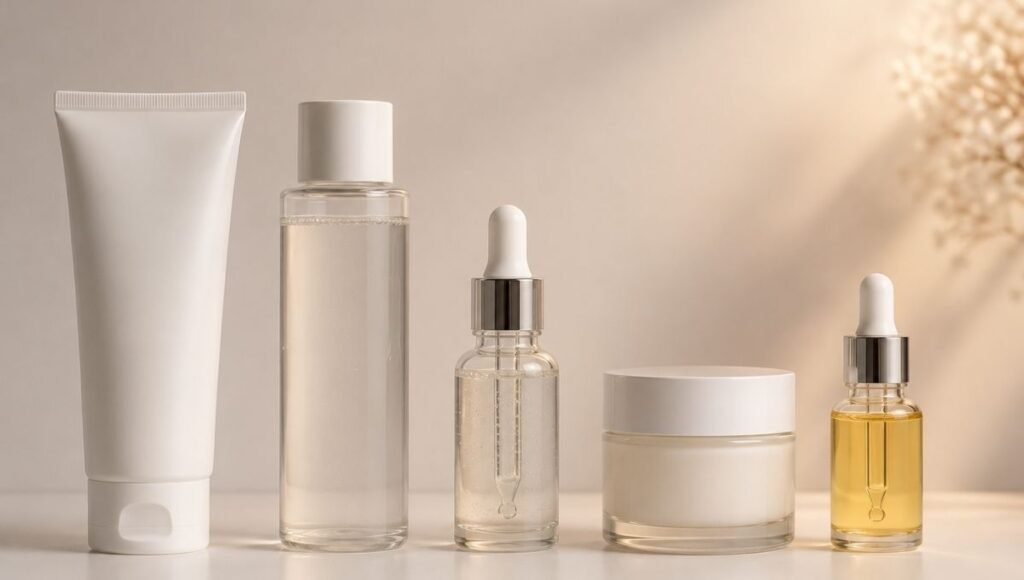
Night skincare follows the same thinnest-to-thickest logic as morning routines, but the steps are slightly different because you’re not applying SPF and you have more flexibility to use treatment products.
The complete night skincare routine order:
Step 1: Makeup removal (if you wore makeup or SPF) Oil-based first — cleansing balm, cleansing oil, or micellar water — to dissolve makeup, sunscreen, and excess sebum. Follow with your regular cleanser. This two-step process (double cleansing) is especially important if you wore sunscreen, which doesn’t fully come off with a single water-based cleanser.
Step 2: Cleanser Your regular gentle cleanser. If you didn’t wear makeup, this is your only cleansing step.
Step 3: Toner (optional) Hydrating toner adds a layer of water-based hydration before your serums. Not essential, but useful if you have dry or dehydrated skin.
Step 4: Treatment serum This is where retinol, AHA/BHA exfoliants, or any active treatment goes. Night is the right time for these because they’re often photosensitive or work best during overnight cell repair cycles.
Step 5: Moisturizer Seals in everything that came before it and supports overnight barrier repair.
Step 6: Face oil or occlusive (optional) A few drops of face oil or a thin layer of squalane on top of moisturizer boosts overnight hydration. For very dry skin, this is worth adding.
That’s the complete routine. Most nights you’ll do Steps 1-5. Steps 3 and 6 are optional based on your skin’s needs.
Editor’s note: The night routine is where real skin change happens. Daytime is about protection; nighttime is about repair. If you’re going to invest in one part of your skincare, the evening routine is it.
Retinol Before or After Moisturizer?
This is the most searched retinol question — and the answer has nuance based on where you are in your retinol journey.
The standard approach: retinol before moisturizer.
Apply retinol to clean, dry skin after your toner or first serum, then apply moisturizer on top. This gives retinol direct access to your skin where it’s most effective.
The beginner approach: the “sandwich method.”
If you’re new to retinol and your skin is sensitive, the sandwich method reduces irritation while still delivering results:
- Apply moisturizer first
- Wait a few minutes
- Apply retinol on top of the moisturizer
- Apply another layer of moisturizer on top
The moisturizer layers buffer the retinol and slow its absorption, reducing the redness, peeling, and dryness that often happens when beginners start retinol. It’s slightly less potent than direct application, but it’s how you build up tolerance without destroying your skin barrier in the process.
When to transition to standard application: Once you’ve used retinol 2-3 times per week for 4-6 weeks without significant irritation, try applying it to clean, dry skin before moisturizer. Start with this method just 1-2 nights per week before building up.
Drugstore retinol picks for beginners:
- Differin Adapalene Gel 0.1% (~$14) — technically an OTC retinoid (adapalene), not retinol, but considered more effective and less irritating than many OTC retinols. Originally prescription-only, now available at most drugstores.
- RoC Retinol Correxion Line Smoothing Serum (~$21) — gradual release formula, good for sensitive beginners
- L’Oréal Revitalift 0.3% Pure Retinol Night Serum (~$30) — higher concentration, for after you’ve built some tolerance
Can You Use Niacinamide with Retinol?
Yes. The claim that you can’t mix niacinamide and retinol is a persistent myth.
The concern originated from a 1960 study suggesting that niacinamide could convert retinol into a less effective form. More recent research has found this doesn’t happen at the concentrations used in skincare products, and in normal skin conditions.
In practice, niacinamide actually pairs well with retinol because it helps support the skin barrier — which retinol can temporarily compromise, especially in the early weeks of use. Using them together means the niacinamide helps offset some of the potential irritation from retinol.
How to layer them: Apply niacinamide serum before retinol (thinner product first), or use a moisturizer containing niacinamide on top of your retinol application.
What this means for your routine: If you use niacinamide for oil control or pore minimizing, you don’t need to choose between it and retinol. Use both.
What Not to Mix with Retinol
While niacinamide is safe with retinol, a few combinations genuinely don’t work well together:
Vitamin C + retinol (on the same night): Both can be irritating, and their different pH requirements mean they don’t work optimally together. The solution: vitamin C in the morning, retinol at night. They’re better separated than combined.
AHA/BHA exfoliants + retinol (on the same night): Both increase cell turnover and can cause significant irritation when used simultaneously, especially for beginners. Use exfoliants on nights when you’re not using retinol — typically alternating nights, or exfoliants 1-2x per week on different nights than retinol.
Benzoyl peroxide + retinol: Benzoyl peroxide can oxidize and deactivate retinol, making both less effective. Use one or the other, not both on the same night.
The safe combinations:
- Retinol + niacinamide ✅
- Retinol + hyaluronic acid ✅
- Retinol + ceramides ✅
- Retinol + peptides ✅
Can You Use Retinol Every Night?
Not when you’re starting out — and possibly never, depending on your skin.
Retinol works by increasing cell turnover, which is what makes it effective for anti-aging, acne, and texture. But this accelerated turnover also means your skin needs recovery time, especially in the beginning.
The beginner retinol schedule:
- Week 1-2: Once per week
- Week 3-4: Twice per week
- Month 2: Every other night
- Month 3+: Assess how your skin is responding
Some people build up to nightly use. Others find that 3-4 nights per week is their sweet spot — enough to get results without constant irritation. There’s no universal right answer; it depends on your skin’s tolerance.
Signs you’re using retinol too often:
- Persistent redness that doesn’t fade between applications
- Painful sensitivity — skin stings when you apply other products
- Severe peeling that doesn’t improve over several weeks
- Skin feels raw or tight constantly
If any of these happen, scale back significantly and let your barrier recover before trying again.
Can You Use Vitamin C with Retinol?
Not on the same night — but you absolutely can use both, just at different times.
Vitamin C belongs in the morning (it works with SPF to prevent UV damage). Retinol belongs at night (it’s photosensitive and works during overnight cell repair). Using them at different times of day means you get the full benefit of both without any compatibility issues.
The schedule: vitamin C serum every morning, retinol every second or third night. This is one of the most evidence-backed skincare combinations available — they address different concerns through different mechanisms, and separating them by time of day makes them both more effective.
Night Skincare Routine for Oily Skin
Oily skin at night doesn’t need less moisture — it needs the right kind of moisture, plus targeted treatment for whatever’s causing the oiliness in the first place.
The night routine for oily skin:
Double cleanse: Even more important for oily skin — leftover sunscreen and excess sebum overnight is a major contributor to clogged pores.
BHA exfoliant (2-3 nights per week): Salicylic acid is oil-soluble and penetrates pores to clear the buildup that causes blackheads and breakouts. The Ordinary Salicylic Acid 2% Solution (~$7) or Paula’s Choice Skin Perfecting 2% BHA (~$35) are both effective options.
Niacinamide serum: Regulates sebum production over time. Can be used on the same nights as BHA or retinol if your skin tolerates it.
Lightweight gel moisturizer: The same product you use in the morning — gel moisturizers at night are sufficient for oily skin and won’t contribute to morning shine.
Skip: Face oils, heavy creams, anything labeled “rich” or “intensive” — these are for dry skin and will make oily skin worse.
For the complete oily skin routine: Oily Skin Care Routine →
What Is Face Slugging?
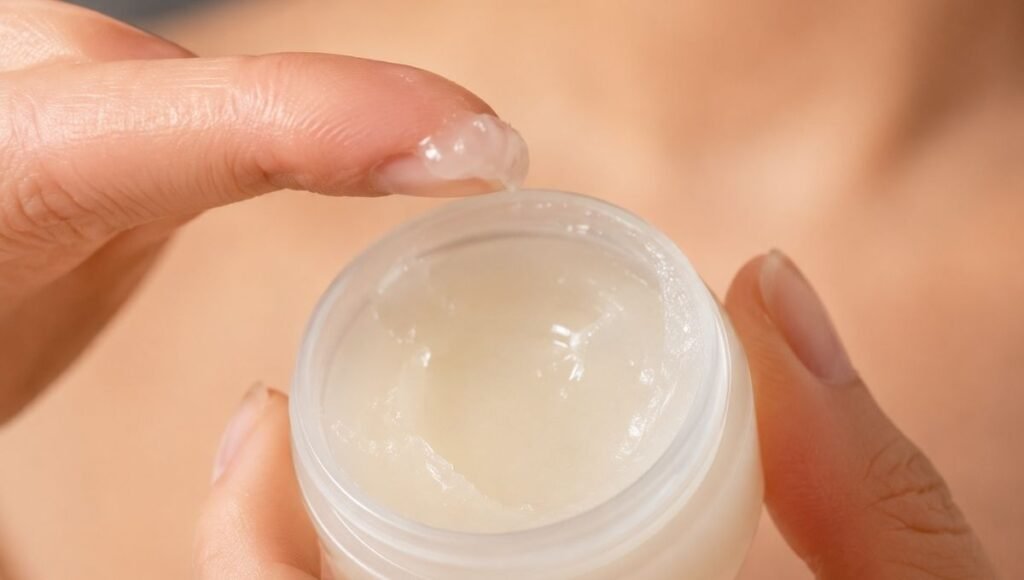
Face slugging is a skincare technique that involves applying a thin layer of a petroleum-based occlusive (usually Vaseline or Aquaphor) as the very last step in your nighttime routine, over all your other products.
The term comes from the idea that your skin is left looking like a “slug” — shiny and coated. It originated in Korean beauty communities and went viral on TikTok.
Why it works: Petroleum jelly is one of the most effective occlusives available — it creates a seal over your skin that prevents transepidermal water loss (the evaporation of moisture from your skin overnight). It doesn’t add moisture itself; it prevents existing moisture from leaving.
Who it’s best for: Dry and very dry skin, people experiencing skin barrier damage, anyone who wakes up with tight or uncomfortable skin despite using a moisturizer.
How to do it:
- Complete your full nighttime routine
- As the absolute last step, apply a very thin layer of Vaseline or Aquaphor to your face
- Sleep. Wake up to noticeably softer skin.
Who should avoid it: Oily and acne-prone skin — the occlusive can trap comedogenic products against your skin. If you slug and break out more, stop.
Cost: A large jar of Vaseline costs about $4 and lasts months. One of the highest-value skincare moves available.
The 2-Minute Night Routine (For Exhausted Evenings)
On nights when doing the full routine feels impossible:
If you wore makeup: Micellar water on a cotton pad, wipe face until cotton comes away clean, done. This is not perfect makeup removal, but it’s significantly better than sleeping in full makeup.
If you didn’t wear makeup: Splash water on your face, apply moisturizer, done.
The two-step minimum: Makeup removal + moisturizer. That’s it. Your skin will thank you for even this much more than it would thank you for nothing.
When to See a Dermatologist
If you’ve been using retinol consistently for 3+ months and seeing significant irritation that doesn’t improve, or if you’re experiencing skin reactions that don’t respond to simplified routines — a dermatologist can help identify whether prescription-strength retinoids, barrier-repair treatments, or specific diagnoses (rosacea, eczema) are what your skin actually needs.
FAQ
What order does night skincare go in?
Makeup removal → cleanser → toner (optional) → treatment serum (retinol, AHA/BHA, niacinamide) → moisturizer → face oil or occlusive (optional). Thinnest products first, thickest last.
Does retinol go before or after moisturizer?
For beginners: try the sandwich method — moisturizer, then retinol, then moisturizer — to reduce irritation while building tolerance. For experienced users: retinol before moisturizer gives slightly better absorption. Both approaches work.
Can you use niacinamide with retinol?
Yes. The claim that they can’t be mixed is based on outdated research. Niacinamide can be used with retinol and actually helps support the skin barrier, which retinol can temporarily disrupt.
What should you not mix with retinol?
Avoid using vitamin C, AHA/BHA exfoliants, and benzoyl peroxide on the same night as retinol. Vitamin C belongs in the morning; exfoliants and retinol should alternate nights rather than being used simultaneously.
Can you use retinol every night?
Not when you’re starting out. Begin with once or twice per week and build up gradually over several months. Some people eventually use it nightly; others find 3-4 nights per week is their skin’s tolerance. Signs you’re using it too often include persistent redness, stinging, and severe peeling.
Your Night Routine Is Where the Real Work Happens
The morning routine is about protection. The night routine is about repair — and repair takes time, not a ten-step routine. A consistent three-step evening routine (cleanse, treatment, moisturize) done every night produces better long-term results than an elaborate twelve-step routine done twice a week.
Start simple. Add retinol when you’re ready. Learn the ingredient combinations that work and the ones that don’t. And on the nights you’re exhausted — a two-minute version still counts.
Keep building your routine on MyColorKiss:
- Morning Skincare Routine — the complete guide to your AM routine and when to use vitamin C
- How to Remove Makeup Properly — the double cleanse method that actually gets everything off
- Skincare Routine for Beginners — find your skin type and build your complete routine
- How to Get Clear Skin — how retinol and BHA fit into a clear skin routine
And remember — the best night skincare routine is the one you actually do. A simple routine every night beats a perfect routine twice a week.
References: Mukherjee S, et al. Retinoids in the treatment of skin aging: an overview of clinical efficacy and safety. Clinical Interventions in Aging. 2006;1(4):327-348. American Academy of Dermatology Association. Retinoid or retinol? https://www.aad.org/public/everyday-care/skin-care-secrets/anti-aging/retinoid-retinol