

What goes on first, which ingredients belong in the morning vs. night, and how to do it all in under 5 minutes.
You know you’re supposed to have a morning skincare routine. You also know that by 7:45am, when you’re trying to leave the house, “routine” often means splashing water on your face and hoping for the best. And then you feel vaguely guilty about it for the rest of the day, like you’re slowly letting your skin down.
Here’s what nobody tells you: a genuinely effective morning skincare routine takes three to five minutes. Not fifteen. Not a ten-step Korean beauty sequence. Three to five minutes with the right products in the right order, and your skin is prepped, protected, and ready for whatever goes on top of it — including makeup.
This guide covers exactly what a morning skincare routine should include, the correct order to apply everything, which active ingredients belong in the morning vs. at night, and the simple 3-step version for days when you genuinely have no time. All with products you can find at the drugstore for under $20.
Key Takeaways
- A complete morning skincare routine needs only 3 products: cleanser (or just water), moisturizer, and SPF
- Vitamin C serum belongs in the morning — it works with sunlight to protect skin from UV damage
- Retinol belongs at night only — sunlight degrades it and increases photosensitivity
- Niacinamide can be used morning or night — both work equally well
- The entire 3-product morning routine takes under 3 minutes
Should You Wash Your Face in the Morning?
This is genuinely debated in skincare communities — and the honest answer is: it depends on your skin type.
If you have oily or acne-prone skin: Yes, cleanse in the morning. Your skin produces oil overnight, and that oil mixed with your pillow’s bacteria and any leftover product residue benefits from a fresh start.
If you have dry or sensitive skin: A water rinse only (no cleanser) is often sufficient in the morning. Your skin doesn’t produce enough overnight oil to require cleansing, and using a cleanser twice daily can strip the moisture barrier you spent the previous evening rebuilding.
If you have combination skin: Use a gentle gel cleanser in the morning on your T-zone if it feels oily, or stick to water if your skin feels comfortable.
The general rule: if your skin feels tight, dry, or uncomfortable after morning cleansing, your cleanser is too harsh or you’re cleansing when you don’t need to. Listen to how your skin actually feels rather than following a rigid routine.
Editor’s note: I switched from morning cleansing to morning water-rinse only for my dry-normal skin about two years ago and my skin became significantly less reactive. Sometimes the right skincare move is doing less, not more.
Drugstore morning cleansers (when you do cleanse):
- CeraVe Hydrating Facial Cleanser (~$14) — gentle enough to use morning and night without stripping
- La Roche-Posay Toleriane Hydrating Gentle Cleanser (~$15) — excellent for sensitive or dry skin
- Neutrogena Ultra Gentle Daily Cleanser (~$9) — very mild, good for all skin types
Morning Skincare Routine Order: Step by Step
The rule for morning skincare is the same as makeup: thinnest to thickest. Watery products absorb first; creamy products seal everything in; SPF goes last.

Step 1: Cleanse (or rinse with water)
Start clean. If you’re using a cleanser, keep it gentle and rinse thoroughly. Pat dry — don’t rub.
Step 2: Toner (optional)
If you use a toner, it goes immediately after cleansing, before anything else. For morning routines, a hydrating toner (not an astringent) is most useful — it adds a layer of water-based hydration that the rest of your products can sit on.
This step is genuinely optional. If you don’t have a toner, skip it — it’s not a gap in your routine.
Step 3: Vitamin C serum (optional but highly recommended)
If you own a vitamin C serum, morning is when it goes. More on this below.
Step 4: Moisturizer
Hydrates and seals in everything that came before it. Choose your formula based on skin type: gel for oily, cream for dry, gel-cream for combination.
Step 5: SPF
The most important step of the morning routine — and the one most people skip. SPF goes last in your skincare routine, before any makeup. Apply generously.
That’s the complete morning routine. Five steps, under five minutes, if you move at a reasonable pace. Three steps if you strip it back to the essentials.
Vitamin C Serum: Morning or Night?
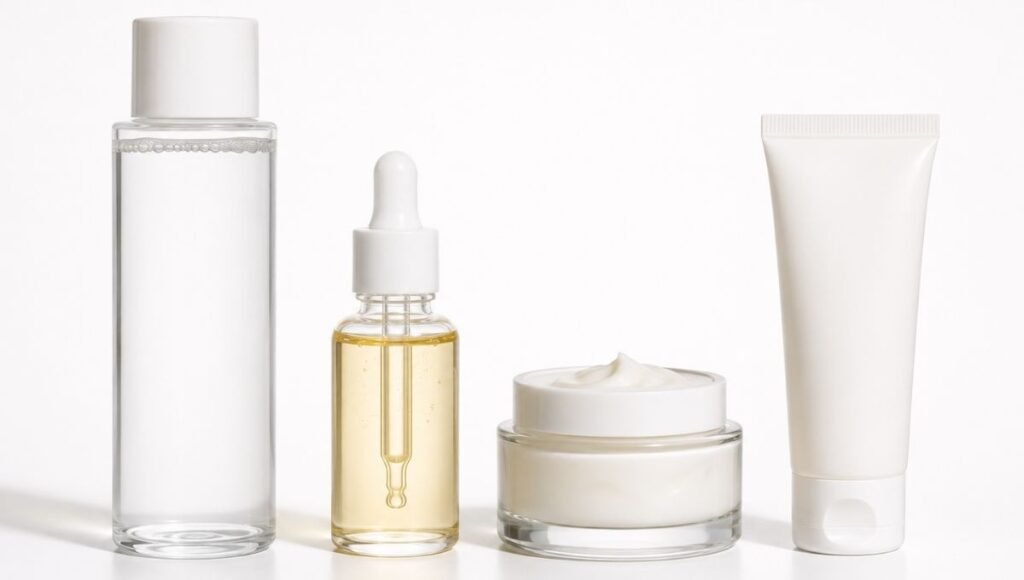
Morning. Always morning.
Here’s why: vitamin C is an antioxidant — it neutralizes free radicals generated by UV exposure, pollution, and environmental stress. Used in the morning before SPF, it enhances your sun protection and helps prevent the oxidative damage that causes dark spots and premature aging.
At night, vitamin C still works, but you lose the synergy with your SPF. If you use retinol at night (which you should), vitamin C and retinol can also interact and reduce the effectiveness of both.
The caveat: Vitamin C is unstable and degrades when exposed to light and air. Look for formulas in opaque or dark packaging, and replace your vitamin C serum every 3-4 months. If it’s turned orange or brown, it’s oxidized and less effective.
Signs your vitamin C serum has gone bad: It smells different (often like hot dogs or something “off”), it’s turned a deep orange, or it’s been sitting open for more than 6 months.
Drugstore vitamin C options:
- TruSkin Vitamin C Serum (~$20) — consistently recommended, stable formula, good for beginners
- L’Oréal Revitalift 10% Pure Vitamin C Serum (~$30) — more widely available, effective concentration
- The Ordinary Ascorbyl Glucoside Solution 12% (~$12) — more stable form of vitamin C, gentler, good starting point
Niacinamide: Morning or Night?

Either — or both. This is one of the most flexible skincare ingredients.
Niacinamide (vitamin B3) regulates oil production, reduces pore appearance, fades dark spots, strengthens the skin barrier, and reduces inflammation. None of these effects are time-sensitive — niacinamide works consistently regardless of when you use it.
If you’re using it to control daytime shine: morning. If you’re using it for overnight repair and barrier support: night. If you’re using it for both: use it twice a day — it’s gentle enough for that.
One note: There’s a persistent myth that niacinamide and vitamin C can’t be used together. This isn’t accurate — they can be layered. Apply vitamin C first (it needs to absorb into skin before anything goes on top), then niacinamide.
Drugstore picks:
- The Ordinary Niacinamide 10% + Zinc 1% (~$7) — the most consistently recommended drugstore niacinamide, excellent for oily skin
- Good Molecules Niacinamide Serum (~$8) — slightly gentler, good for sensitive or combination skin
Hyaluronic Acid: Morning or Night?

Morning is ideal — but it requires one important technique.
Hyaluronic acid is a humectant — it draws moisture toward itself. Applied on damp skin (right after cleansing, while skin is still slightly wet), it draws atmospheric moisture into your skin and holds it there.
Applied on completely dry skin in a dry environment, it can actually pull moisture from deeper layers of your skin — temporarily making dryness worse. This is the technique detail that most guides skip over.
The rule: Apply hyaluronic acid immediately after cleansing or toning, while skin is still slightly damp. Follow immediately with moisturizer to seal it in.
At night, the same principle applies — but the overnight hours give it more time to work, which some people prefer for dry skin.
Drugstore picks:
- The Ordinary Hyaluronic Acid 2% + B5 (~$9) — lightweight, absorbs quickly, pairs well with any moisturizer
- Neutrogena Hydro Boost Water Gel (~$18) — contains hyaluronic acid in a moisturizer format, one fewer step
Morning Skincare Routine for Oily Skin

Oily skin in the morning needs a slightly different approach than the general routine — specifically, you want to cleanse (oily skin does produce enough overnight oil to warrant it), avoid heavy moisturizers, and focus on oil control.
The oily skin morning routine:
Cleanse: Gel or foaming cleanser with salicylic acid or a gentle sulfate-free formula. The CeraVe Foaming Facial Cleanser (~$14) or Neutrogena Oil-Free Acne Wash (~$9) both work well.
Niacinamide serum: Apply after cleansing — niacinamide is the most useful morning ingredient for oily skin because it regulates sebum production over time.
Lightweight gel moisturizer: Oil-free and water-based. The Neutrogena Hydro Boost Water Gel (~$18) or CeraVe Oil Control Moisturizing Gel-Cream (~$16) are both excellent.
Oil-free SPF: Look for formulas labeled “oil-free,” “matte finish,” or specifically formulated for oily skin. The Neutrogena Clear Face Liquid Lotion SPF 55 (~$14) is designed for this.
What to skip in the morning: Heavy creams, facial oils (save those for evening), anything with shimmer or glow-enhancing properties.
For the complete oily skin routine including evening steps and how to control midday shine: Oily Skin Care Routine →
Morning Skincare Routine with Makeup: How to Layer Correctly

When you’re applying makeup after your morning skincare routine, timing and layering matter more than most guides acknowledge.
The two most common problems:
Pilling: Skincare products balling up under foundation. This happens when products haven’t fully absorbed, when silicone-based skincare is layered under water-based foundation, or when too many thick products are stacked.
SPF degradation: Applying foundation directly over SPF without letting it absorb can disrupt the SPF film and reduce protection.
The solution: Give your SPF 1-2 minutes to absorb before applying primer or foundation. That’s it. You don’t need to wait 20 minutes — you just can’t apply makeup immediately on top of a still-wet SPF layer.
The correct morning order when wearing makeup: Cleanser → toner → serum → moisturizer → SPF (wait 1-2 minutes) → primer (optional) → foundation → the rest of your makeup
For the complete makeup application guide including how to blend foundation over SPF without pilling: How to Apply Foundation for Beginners →
The 3-Step Morning Skincare Routine (For Rushed Days)
On days when you have 90 seconds and not a moment more:
Step 1: Rinse face with lukewarm water — 20 seconds Step 2: Apply moisturizer — 20 seconds Step 3: Apply SPF — 20 seconds
That’s it. Those three steps protect your skin barrier, maintain hydration, and prevent UV damage — the three things your skin most needs from a morning routine. Everything else is an enhancement, not a foundation.
What If Your Morning Routine Isn’t Working?
Skin feels tight and dry after cleansing: Your cleanser is too harsh for your skin type. Switch to a gentler formula, or consider skipping the morning cleanser and just rinsing with water.
Makeup not lasting through the day: You’re either skipping SPF (which creates a slippery surface for some formulas) or your moisturizer is too heavy and isn’t absorbing fully before makeup goes on. Let your skincare absorb for 1-2 minutes before foundation.
Skin looks dull or flat by midday: You may be skipping vitamin C serum, which makes a visible difference in skin brightness over time. Add it to your morning routine before moisturizer.
Products are pilling: You’re layering too fast or mixing incompatible formulas. Let each product absorb 30 seconds before the next. Also check whether your sunscreen and moisturizer are compatible — silicone-based products often don’t layer well under water-based formulas.
FAQ
Should you wash your face in the morning?
It depends on your skin type. Oily and acne-prone skin benefits from morning cleansing. Dry and sensitive skin often does better with a simple water rinse — twice-daily cleansing can strip the moisture barrier for skin types that don’t need it.
What order should morning skincare go in?
Cleanser → toner (optional) → serum → moisturizer → SPF. The rule is thinnest to thickest — watery products first, creamy products last, SPF always final.
Does vitamin C serum go in the morning or at night?
Morning. Vitamin C is an antioxidant that works synergistically with SPF to neutralize UV-related free radical damage. It’s significantly more effective used before sun exposure than after.
Can you use niacinamide in the morning?
Yes — niacinamide works equally well morning or night, and it’s gentle enough to use twice daily. For oily skin, morning use is particularly useful because it helps regulate daytime sebum production.
How long should you wait between skincare and makeup?
1-2 minutes after applying SPF is sufficient for most skin types and formulas. You don’t need to wait 20-30 minutes — you just need to let the SPF film set before applying anything on top.
A Good Morning Skincare Routine Doesn’t Take Long — It Just Takes Consistency
Three products. Three minutes. Done every morning.
The research is clear: consistent use of basic skincare — cleanser, moisturizer, SPF — produces better long-term skin outcomes than an elaborate routine done sporadically. You don’t need twelve steps. You need three steps, every day, without skipping.
Start there. Add vitamin C when you’re ready. Add niacinamide when you want to target specific concerns. Build slowly and let your skin tell you what it responds to.
Keep building your routine on MyColorKiss:
- Skincare Routine for Beginners — the complete guide to finding your skin type and building your full routine
- Does Sunscreen Prevent Tanning — everything you need to know about SPF application
- Natural Makeup Look Tutorial — how to apply makeup over your prepped morning skin
- Oily Skin Care Routine — morning and evening routine specifically for oily skin
And remember — the best morning skincare routine is the one that actually happens. A 90-second routine every morning beats a perfect 15-minute routine that you skip three days a week.
References: American Academy of Dermatology Association. Skincare tips dermatologists use. https://www.aad.org/public/everyday-care/skin-care-basics/care/skin-care-tips-dermatologists-use Telang PS. Vitamin C in dermatology. Indian Dermatology Online Journal. 2013;4(2):143-146.